If you’ve ever worked in electrical distribution, you know the pressure to pick gear that’s reliable in the elements, cuts maintenance costs, and holds up over decades. As someone who’s been an outdoor VCB supplier for 12 years, I get it—field teams don’t have time to troubleshoot gear that fails when it rains, freezes, or gets blasted with dust. The question I get more than any other right now is this: how does outdoor VCB stack up against an air break switch (ABS) for outdoor distribution applications? It’s not a one-size-fits-all answer, but after seeing hundreds of projects, I can break it down like I do with my customers, no sales fluff, just real field data. Outdoor VCB
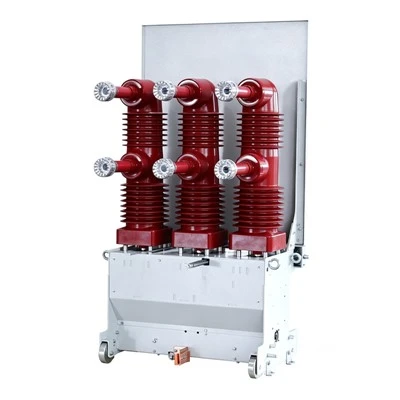
First, let’s start with the basics so we’re on the same page. An air break switch is a manual or motor-operated switch that uses air as the insulating and interrupting medium. It’s been around for over a century—you’ll see them on pole tops in rural areas, small substations, and even street lighting circuits. Their job is simple: open or close a circuit when the load is off, so you can isolate equipment for maintenance. An outdoor vacuum circuit breaker, or VCB, also interrupts current, but it uses a sealed vacuum chamber inside for the arc interruption and insulation. No open air, no exposed parts. That core difference drives every other comparison, so let’s dive into performance first, starting with interrupting capacity.
Interrupting capacity is make or break for equipment. If a fault hits a distribution line—say, a tree falls on a conductor, or a lightning strike creates a short—you need gear that can stop that fault current fast, without damaging itself or causing a blackout. Air break switches, even the high-voltage models, max out at around 20,000 amps of fault current interruption. Most rural grids run at 15,000 amps or less, so that works for simple, low-fault applications. But for industrial substations, urban distribution, or utility grids with higher fault levels (some run 30,000 amps or more), an ABS won’t cut it. The arc an ABS creates when interrupting that high current is huge—hundreds of degrees, actually—and it can cause flashovers, damage to the switch contacts, or even reignite the fault. Outdoor VCBs, on the other hand, routinely handle 31,500 to 40,000 amps of fault current, and they do it in milliseconds. The vacuum chamber quenches the arc so fast there’s no chance of reignition. I remember a customer in Ohio a few years back had a 25kV distribution line that kept tripping because of tree-related faults; they had old ABSs that would take 2 to 3 seconds to clear a fault, causing downstream transformers to overheat. We swapped in outdoor VCBs, and fault clearing time dropped to 0.08 seconds. Their transformer failures dropped 90% that year. That’s a real win, not a spec sheet number.
Next, environmental robustness—this is non-negotiable for outdoor gear. An air break switch is, well, open to the air. Rain, snow, dust, salt, even bird droppings can get between its contacts, corrode them, or build up on insulators until it causes a flashover. I’ve had customers in the Gulf Coast tell me their ABSs would fail every 18 months because salt spray ate through the contact plating. Out in the Midwest, dust and cottonwood sap would build up on ABS insulators, forcing line crews to climb poles to clean them twice a year. Outdoor VCBs, though, their core interrupting chamber is fully sealed in a steel or ceramic casing. The only external parts are the operating mechanism and the bushings—those are rated for IP65 or higher, meaning they’re dust-tight and can handle high-pressure water spray. We supply units that have passed 10,000 hours of salt spray testing, per IEC standards, and they’re rated for -40°C to 60°C operating temperatures. Last winter, a customer in northern Minnesota told me his outdoor VCB had been through three blizzards, wind chills hitting -50°F, and it never missed a cycle. His old ABS would seize up from ice on the operating linkage two or three times a season. That’s not just convenience—it’s safety; if a switch seizes, you can’t isolate a fault, which puts line crews at risk.
Maintenance is another big one, and this is where a lot of customers miss the fine print. Air break switches require regular, hands-on upkeep. You have to inspect the contact points every 6 to 12 months, clean the insulators of dirt and debris, lubricate the linkage, and test the interrupting mechanism. If you skip that, corrosion or wear builds up, and eventually the switch won’t open or close when you need it. Outdoor VCBs? The sealed vacuum chamber means there’s almost no wear on the interrupting contacts. The only internal part that moves is a small plunger, and in 12 years of supplying outdoor VCBs, I’ve had maybe 5 warranty claims related to contact wear—and those were for units that had been operating in highly corrosive industrial areas for 10+ years. Most outdoor VCBs only need a full inspection every 5 to 10 years, and that’s just checking the operating mechanism and bus connections, not the interruption chamber. For utilities with large fleets, that translates to tens of thousands of dollars a year saved on line crew time, bucket truck rentals, and parts. I recently worked with a mid-sized utility in Texas that switched all their pole-top switching gear from ABS to outdoor VCBs. They calculated that maintenance costs dropped 72% in the first two years, which paid for the equipment upgrade in 18 months. That’s a return on investment almost no other gear can match.
Wait, but let’s be fair—air break switches aren’t useless. There are still use cases where ABS makes perfect sense. If you’re working on a small, rural line with low fault current, or a temporary installation where you just need a simple disconnect, an ABS is cheap upfront. A basic 15kV ABS costs a third of what a comparable outdoor VCB does. But that upfront cost is a trap for long-term projects. I’ve had customers tell me they saved $2,000 on a switch, but then spent $8,000 over three years on maintenance and repairs. For applications where you need reliable operation, high interrupting capacity, or long service life, that upfront premium is way worth it. Another point: operating speed. When a fault hits, you need to clear it fast to protect equipment. Most air break switches take 0.5 to 2 seconds to interrupt current, because their arc quenching is slower. Outdoor VCBs operate in 20 to 50 milliseconds. That speed difference is the difference between a transformer failing and surviving, or a circuit staying online during a fault. For critical applications—like hospitals, data centers, or industrial plants that can’t afford downtime—that speed isn’t a luxury, it’s a requirement.
I also want to address a common misconception: people think vacuum breakers are more complicated, so they’re harder to service. That’s not true anymore. Modern outdoor VCBs are designed with user-friendly operating mechanisms, and most can be maintained without specialized tools, unlike older models that needed factory technicians. Plus, the sealed vacuum chamber means you don’t have to replace any internal components for 20 to 30 years. An air break switch’s contacts, by contrast, wear out every 5 to 10 years, so you’re replacing parts every few cycles.
So when should you pick which? Let’s break it down: go with an air break switch if you need a low-cost, simple disconnect for low-fault, temporary, or small rural applications. Go with an outdoor VCB if you need high reliability, high interrupting capacity, low maintenance, and long service life—urban distribution, industrial substations, critical infrastructure, or areas with harsh weather or corrosive environments.

At the end of the day, the goal for any electrical gear is to keep the power on, keep crews safe, and keep costs down. I’ve seen too many customers cut corners on switching gear, only to deal with costly outages and repairs down the line. If you’re planning a project, whether it’s a new substation, a pole-top upgrade, or a network reliability overhaul, you don’t have to figure this out alone. I’ve worked with thousands of utilities, contractors, and industrial operators, and I can help you pick the right outdoor VCB for your specific needs, no hard sell, just honest advice. If you’re ready to talk about your project, or have questions about specs, installation, or maintenance, feel free to reach out.
Outdoor VCB References
- IEC 60694: Common specifications for high-voltage switchgear and controlgear standards
- Electric Power Research Institute (EPRI) Report on Distribution Switchgear Reliability, 2021
- IEEE Std C37.12: Standard for Air Break Switches for AC Systems
- International Association of Electrical Inspectors (IAEI) Outdoor Switching Gear Performance Study, 2022
Juhui Power Equipment Co., Ltd.
With abundant experience, we are one of the most reliable outdoor vcb manufacturers and suppliers in China. Please feel free to buy bulk outdoor vcb made in China here from our factory. Welcome to contact us for customized service and pricelist.
Address: No. 25 Dongzhen Road, Xiangyang Industrial Zone, Yueqing City, Wenzhou City, Zhejiang Province
E-mail: JuHui99998@outlook.com
WebSite: https://www.juhuipower.com/
