If you’ve ever walked through a sun-dappled backyard where afternoon breeze carries the faint rustle of leaves and the soft, earthy scent of wood, chances are you’ve paused to admire a structure that feels both timeless and effortlessly at home in its surroundings: a bamboo pergola. As a bamboo pergola supplier, I’ve spent years seeing people react to these structures with that same quiet pause—they’re not just garden fixtures, and they’re not just another wood framework. There’s a distinct aesthetic appeal to bamboo pergolas that sets them apart from every other outdoor structure on the market, and it’s not just about how they look. It’s a mix of science, tradition, and a kind of quiet intentionality that you can feel the second you step under one. Bamboo Pergola
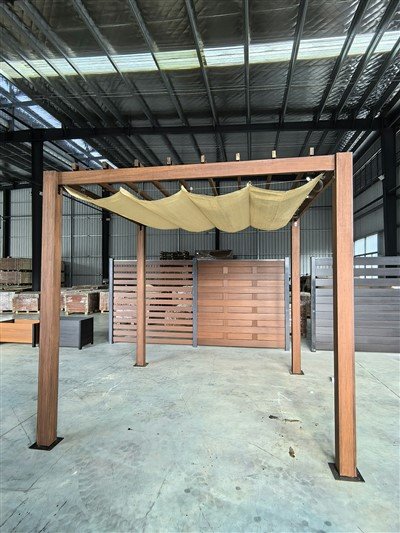
Let’s start with the basics most people notice first: the texture and tone of bamboo itself. Unlike cedar, which can lean into reddish-orange or gray as it ages, or vinyl, which never feels quite natural, bamboo has a unique, subtle color palette that shifts with light and time. Freshly harvested bamboo has a warm, honeyed hue—think of the inside of a sunlit beehive, soft and golden with faint, darker nodes spaced evenly along each pole. Those nodes aren’t just a quirk of the plant; they’re a natural texture that adds depth without feeling overdone. Run your hand along a bamboo pole, and you’ll feel gentle, raised ridges that don’t grab at your skin, unlike the rough grain of unprocessed cedar or the smooth, plastic-like surface of composite materials. It’s a texture that balances solidity with softness, which is part of why it feels so inviting.
But the aesthetic isn’t just about color or texture. Bamboo is a grass, not a wood, and that botanical identity shapes its entire visual appeal. Unlike the straight, uniform grain of most lumber, bamboo has a layered, almost fibrous structure that gives it a soft, organic line. When we bend bamboo into the curves common in many pergola designs, or join poles with natural fiber ties instead of metal screws, we’re not just building a structure—we’re working with a material that grows in curves and flexibility, not just straight lines. That’s a key point I often explain to clients who think bamboo is too “flimsy” for outdoor use: its flexibility is part of what makes it beautiful. A cedar pergola has hard, sharp angles; a bamboo pergola has gentle transitions, soft curves where the poles meet, and a lightness that makes it feel like an extension of the trees around it, not a separate, imposed structure.
Then there’s the light. This is where the science of bamboo really ties into its aesthetic. Bamboo poles are hollow, and when we space them across the top of a pergola (the slats, or “lattice” that forms the roof), we leave gaps that are specific to how thick and dense the bamboo is. Those gaps don’t just let rain through—they filter sunlight into dappled patches that move across the space underneath as the day goes on. On a mid-morning summer day, the light under a bamboo pergola is bright enough to feel open, but soft enough that you can sit there without squinting, and without the harsh glare that comes under a solid roof. I’ve had clients tell me their kids draw on the floor under the pergola at this time of day, because the light is gentle enough that even crayon marks show up clearly, but the shade keeps the area cool enough to play for hours. It’s a subtle, dynamic light that changes with the weather, too—on a cloudy day, the gaps diffuse the gray light so it feels even and calm; on a rainy day, the sound of drops hitting the bamboo poles is soft, not the loud, echoing tap that happens on a metal or plastic roof. That interplay of light and material is an aesthetic that doesn’t feel forced; it’s built into how bamboo grows.
What makes this even more special is how bamboo’s aesthetic connects to a sense of sustainability, which has become a big part of how people design their outdoor spaces lately. For a long time, outdoor structures were seen as disposable—cedar would rot in five years, composite would fade in ten, metal would rust. Bamboo, though, is one of the fastest-growing plants on Earth: some species can grow up to three feet in a single day, which means it’s harvested without clear-cutting forests. When we source bamboo for our pergolas, we only take mature stalks that are already past their productive growing years, so the plant regrows without needing replanting or disturbing the soil. That sustainability isn’t just a marketing buzzword; it’s an aesthetic that adds depth to the structure. When you sit under a bamboo pergola, you’re not just looking at a pretty frame—you’re looking at something that came from a plant that works with the environment, not against it, and that’s a quality that feels timeless, not trendy.
I also think a lot of the appeal comes from how bamboo pergolas blend into different design styles. Some clients want a bohemian, tropical feel—they hang string lights, potted orchids, and wind chimes from the pergola, and the soft bamboo lines feel like they belong in that relaxed, lush space. Others have a modern, minimalist backyard with clean concrete patios and native grasses, and a bamboo pergola adds a warm, organic contrast that softens the sharp edges of the hardscaping. Even traditional or farm-style yards work with bamboo: we’ve built pergolas for properties with old oak trees and flower beds, and the bamboo’s natural tone matches the weathered wood of fences and garden beds better than any other material I’ve seen. It’s that versatility that makes bamboo so appealing—you don’t have to redo your whole backyard to fit a bamboo pergola; it adapts to what you already have.
But here’s something most people don’t talk about: the patina. Unlike vinyl, which never changes, or cedar, which fades to a dull gray, bamboo ages in a way that feels intentional. In the first year, it will fade a little from its original honey color to a softer, warmer tan, as it’s exposed to UV light and rain. Over time, it will develop a silvery sheen in spots that get the most sun, and darker patches in the shaded areas, creating a natural, uneven patina that’s unique to every pergola. No two bamboo pergolas age the same way—each one takes on the colors and light of its specific yard, which means it’s never just a “prefabricated” structure; it becomes a personal part of the home. I’ve had clients send me photos of their pergolas five or ten years after installation, and the way the light hits those aged bamboo poles is even more beautiful than the day we put it up—like the structure has grown old with the family, not just been there as a static feature.
Now, I know some people still have questions: is a bamboo pergola strong enough? Will it attract bugs? Let’s address those, because they tie directly to the aesthetic too. When we process bamboo for pergolas, we treat it with natural, non-toxic preservatives (no harsh chemicals that would leave a smell or alter the bamboo’s texture) that repel insects and resist rot. And because bamboo has a higher tensile strength than steel (that’s a scientific fact—bamboo can support up to 28,000 pounds per square inch, while steel is around 30,000), it’s strong enough to hold up to wind, rain, snow, and even heavy hanging plants or lights. So you don’t have to choose between beauty and function—bamboo gives you both.
As a supplier, I’ve spent years working with homeowners, landscapers, and even architects to refine what makes a bamboo pergola look and feel right. We don’t just cut poles to length; we take the time to select bamboo with consistent node spacing, straight, even grain, and the right density to hold up outdoors without feeling heavy. We use natural fiber ties (hemp or jute, usually) to join the poles, which add to that soft, organic look, and we leave the ends of the poles slightly uneven, just like they would be in nature, instead of cutting them perfectly flat to look “manufactured.” That attention to small, natural details is what makes each pergola we build stand out—no two are identical, just like no two backyards are identical.
At the end of the day, the aesthetic appeal of a bamboo pergola isn’t just about how it looks in a photo. It’s about the experience of sitting under it at the end of a long day, feeling the breeze move through the gaps in the slats, seeing the dappled light on the patio, and smelling the faint, woody scent of bamboo. It’s about a structure that feels like it belongs, not like it was plopped into the yard. It’s about a material that’s beautiful, sustainable, and functional all at once, which is a rare combination in outdoor design.
If you’re thinking about adding a pergola to your backyard, and you want something that’s more than just a functional shade structure—something that adds warmth, texture, and quiet beauty to your space—let’s connect. We work with clients to design custom bamboo pergolas that fit their yard, their style, and their budget, and we’re happy to walk through all the options together. Whether you’re looking for a small pergola for a patio dining area, a larger one for a backyard lounge, or something in between, we can help you create a space that feels like an extension of your home, rooted in the natural beauty of bamboo.
Bamboo Planter Box References
- Liese, W. (1987). Bamboo: Some Basic Observations on Its Structure and Properties. Wood Science and Technology.
- van der Lugt, P. (2007). Bamboo as a Building Material: A Review. Construction and Building Materials.
- American Bamboo Society. (2022). Bamboo for Landscape and Outdoor Structures.
- Zhang, M. et al. (2012). Mechanical Properties of Bamboo and Its Application in Structural Engineering. Materials and Structures.
Ningguo Kungtai Bamboo and Wood Co., Ltd.
As one of the most professional bamboo pergola manufacturers and suppliers in China, we warmly welcome you to wholesale bulk customized bamboo pergola from our factory. If you have any enquiry about quotation, please feel free to email us.
Address: East of Huanggang Road, Ningdun Town, Ningguo City, Anhui Province
E-mail: office@hh-bamboo.com
WebSite: https://www.kungtaibamboo.com/
